Electoral Registers for Family Historians
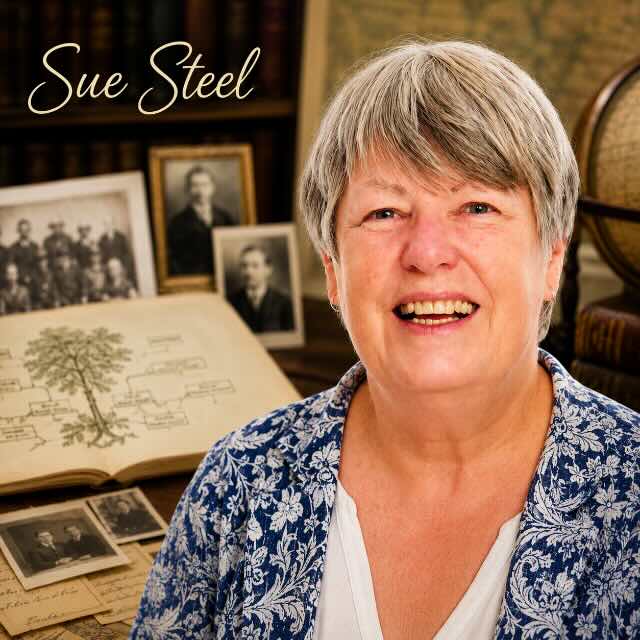
Speaker: Sue Steel, Chair of Bradford Family History Society
Date: 7 September 2026
Meeting format: Zoom
More Than Just a List of Voters
Electoral registers are one of those family history sources that many researchers know about but do not always use to their full potential. At our September meeting, Sue Steel, Chair of Bradford Family History Society, demonstrated just how valuable these records can be — while also explaining some of the traps awaiting the unwary researcher.
Sue readily admitted that electoral registers had sometimes confused her too. Having used them to trace her own ancestors over many years, she decided to investigate exactly who was entitled to appear, how the registers developed and, crucially, what date an entry actually represents.
Using numerous examples from Bradford and the surrounding area, Sue took members through nearly two centuries of electoral history and showed that the registers can reveal far more than simply an address.
Who Had the Vote?
Sue began before the great electoral reforms of the nineteenth century. Before 1832, voting rights depended heavily upon property ownership and local custom. Only a small minority of men could vote, while representation itself was notoriously uneven.
One striking example was Dunwich in Suffolk, much of which had disappeared into the sea centuries earlier, yet the borough continued to return two MPs. Such anomalies, together with corruption, bribery and unequal representation, eventually led to reform.
The Representation of the People Act 1832 widened the franchise and, importantly for family historians, required voters to be entered on lists of registered electors. Electoral registers have consequently been produced from that period onwards, although there are wartime gaps.
Registers were generally produced annually, with no registers for 1916–17 or 1940–44. At certain periods, including 1919–26 and 1945–49, registers appeared twice yearly.
Sue explained that eligibility remained complicated. County and borough qualifications differed, and the vote was still restricted to men. Further reform in 1867 substantially increased the electorate, while changes in 1884 brought many more working-class men into the system.
Women did not gain the parliamentary vote until 1918, and even then it was restricted. However, Sue reminded us of an easily overlooked fact: some women householders had been able to vote in local elections from 1869. This makes the earlier local electoral lists particularly important when searching for female ancestors.
Those Who Could Not Vote
Absence from a register does not necessarily mean that an ancestor had moved away or died.
Sue highlighted a surprisingly long list of people who could at various times be disqualified despite apparently meeting the normal property or residential requirements. These included certain non-British residents, serving policemen during part of the nineteenth century, some government employees, prisoners, people convicted of electoral bribery and First World War conscientious objectors for a period following the war.
This provided an important warning: never draw conclusions from an absent name without first considering whether that person was actually entitled to vote.
Sue illustrated this with Henrik Slawinski, who appeared to be mysteriously absent from registers in which his wife Margaret was listed. Initially, the absence might suggest a separation. Other family evidence showed that this interpretation was unlikely. Sue eventually concluded that his probable non-British nationality and lack of naturalisation offered a much more plausible explanation.
It was an excellent demonstration of why electoral registers should be considered alongside other evidence rather than interpreted in isolation.
Understanding the Different Registers
Sue outlined three principal forms of electoral lists encountered in her Bradford research:
- Burgess Rolls, 1848–1897
- Ward Rolls, 1897–1914
- Electoral Registers, from 1918 onwards
Early Bradford Burgess Rolls listed qualified voters alphabetically within each ward, making individuals comparatively easy to find. From 1883, however, the arrangement changed to streets within wards.
For researchers who do not already know an address, that can make searching considerably harder.
Registers could also be divided according to voting entitlement. Division I generally contained those entitled to vote in both parliamentary and local elections, Division II parliamentary elections only, and Division III local elections only.
Sue particularly emphasised checking all the divisions, especially when looking for women. She admitted that she had more than once failed to find an aunt or grandmother simply because she had looked in the wrong section.
Later registers also contain codes indicating voting qualifications. Rather than guessing their meaning, researchers should check the explanatory pages at the beginning of the volume.
The Date Trap
Perhaps the most important lesson of the evening concerned dates.
An electoral register can involve three different dates: the qualifying date, the date on which the register came into force, and the date on which it ceased to apply.
For family historians, Sue recommended concentrating upon the qualifying date, because this is the date on which the individual's entitlement through residence or occupation was established.
The difference can be significant. Someone might die or move after the qualifying date but before the register came into force and therefore still appear in the published volume.
Sue demonstrated this through her great-grandfather Tom, who appeared with his wife Hannah in a 1925 register despite having died on 8 January 1925. The register came into force later, but its information had been compiled earlier.
A second family example demonstrated the problem from another direction. Sue's grandfather reached the age of 21 on 16 July 1927. Unfortunately for him, the qualifying date was 15 July. He had missed eligibility by just one day and consequently did not appear when Sue initially expected him to.
Her advice was simple: do not automatically accept the year assigned to an online electoral-register entry as the precise date to which the information relates. Check the original register and establish its qualifying date.
Following Families from House to House
Electoral registers become particularly powerful when combined with census returns, certificates and maps.
Sue showed an example involving two families in George Street, Saltaire. Electoral evidence indicated that Harry Smith and another household had apparently exchanged addresses. By comparing the qualifying date of the electoral register with the census of 2 April 1911, it became possible to narrow down when the move had occurred.
Some early registers are even more helpful, recording a “dwelling house successive” qualification and giving both addresses when someone had moved during the relevant period.
Unfortunately, this useful practice did not continue.
Sue recommended establishing an ancestor's address from census returns, certificates or other records before tackling post-1883 registers. Researchers then need to identify the ward containing that street.
Bradford's municipal yearbooks can help enormously. Their street indexes identify wards and polling districts, providing a route into otherwise cumbersome electoral volumes.
The yearbooks themselves should not be overlooked. Sue described volumes containing lists of councillors and mayors, council committees and their responsibilities, cemeteries, schools, libraries, hospitals, churches, council employees and even diaries of local events.
For anyone trying to understand the community in which an ancestor lived, they provide valuable historical context.
Absent Voters and the First World War
A particularly useful section of the talk concerned Absent Voters Lists.
From 1918, servicemen and others away from home could be recorded separately, and these entries may include a serviceman's rank and military unit. They can therefore provide an important lead when investigating First World War service.
Absent voters were not necessarily soldiers. Sue explained that the lists could include merchant seamen, fishermen, Red Cross workers and women serving overseas with organisations supporting the war effort.
Researchers should also remember that the lists were compiled in advance. A serviceman could therefore appear even though he had subsequently been killed, reported missing or taken prisoner.
Sue mentioned holdings and resources including local archives, the British Library, Ancestry, Findmypast, Leeds's database of First World War absent voters and the Long, Long Trail website.
She also drew attention to the 1913–14 electoral lists as a potentially valuable snapshot of men immediately before the First World War.
Searching Online — Browse as Well as Search
Although electoral registers can be searched online, Sue recommended not relying solely upon name searches.
Using Ancestry's West Yorkshire, England, Electoral Registers, 1840–1962 collection, she demonstrated how browsing by parliamentary division and year can sometimes be more effective.
Once an ancestor has been located, make a note of the image or page number. In subsequent years the same street may appear on the same or a nearby page, making it much quicker to follow a household through time.
Early registers can also lead researchers into completely different sources. A nineteenth-century entry might identify someone as a freeholder, owner, tenant or occupier. That in turn could suggest searching for deeds or tenancy documents.
Sue suggested the Registry of Deeds at Wakefield, local archives and historic mapping from the National Library of Scotland as useful next steps. An electoral entry should therefore be regarded not as an end point, but as a clue capable of generating further research.
Where Can Registers Be Found?
Sue's examples concentrated upon Bradford and West Yorkshire, but the principles apply much more widely.
She referred to holdings at Bradford Local Studies Library, Leeds Local Studies Library, Keighley Local Studies Library, Skipton Library, West Yorkshire Archive Service and the British Library, alongside online collections at Ancestry and Findmypast.
Local arrangements vary, so contacting the relevant local studies library or archive can be worthwhile when the whereabouts of registers are uncertain.
During the discussion, Steve Miller noted that some Leeds registers have been moved from open shelves because of data-protection considerations but remain accessible. Sue stressed that published electoral registers are public records, although modern electors can choose to have details omitted from the version made commercially available.
Questions, Memories and Electoral Curiosities
The discussion following the presentation produced several fascinating examples.
Lynda Balmforth recalled finding an ancestor in a register with the handwritten word “dead” beside her name. Subsequent research confirmed that the woman had died close to the relevant date — an unexpected annotation that provided a valuable clue.
Members also remembered the practicalities of elections in earlier decades: candidates arranging cars to take voters to polling stations, loudspeaker cars touring neighbourhoods and campaign workers knocking on doors.
Linda Knock recalled being told in the 1960s that some estate workers still believed their landlord would somehow discover how they had voted, despite the secret ballot having been introduced in 1872. It was a striking reminder of how older attitudes and fears could survive long after the law had changed.
John Holden raised a problem familiar to many researchers: how do you find someone in a twentieth-century register when you know they lived in Bradford but have no address? Unfortunately, where registers are arranged geographically and have not been name-indexed, there may be no shortcut. Census returns and other sources can help establish an address; otherwise, the researcher may face the painstaking task of working through the volumes.
As Sue observed, electoral-register research sometimes requires plenty of patience.
An Underused Family History Resource
Sue's talk demonstrated that electoral registers deserve a much more prominent place in the family historian's toolkit. They can trace a family between censuses, establish periods of residence, identify moves, distinguish household members, provide clues to property ownership and military service, and sometimes explain otherwise puzzling gaps in a family's story.
But they must be interpreted carefully.
The most important lesson of the evening was perhaps that an entry does not necessarily mean somebody was living at an address on the publication date — and an absence does not necessarily mean they were not living there.
Check the qualification rules. Check all the divisions. Check the qualifying date. Look for the street and ward rather than relying solely upon a name search. Then use what you find to lead into censuses, certificates, maps, property records, military sources and local archives.
Lynda Balmforth closed the meeting by thanking Sue for a fascinating presentation that had explored a complicated subject in considerable depth. Sue also prepared a detailed handout to accompany the talk, giving members a useful reference when they begin exploring electoral registers for themselves.
For anyone with gaps between census years — or an ancestor who simply seems to have disappeared — the electoral register may well provide the next clue.