- Speaker: Brian Joyce, volunteer speaker for the Commonwealth War Graves Commission
- Date: Monday 2 November 2026
- Meeting format: Zoom
Introduction
With Remembrance Sunday less than a week away, members gathered online for a talk that was both sobering and inspiring. Brian Joyce took us, in his own words, “on a journey, right from where we started, right through to the work that we’re undertaking” as of today. Over nearly an hour he traced the Commonwealth War Graves Commission (CWGC) from one man’s wartime vision to a global organisation that still cares for the graves and memorials of more than 1.7 million men and women. He made frequent stops in Leeds and Yorkshire along the way.
About the Speaker
Brian is a former military officer who served in recent campaigns and lost colleagues in them. He told us that this experience showed him how deeply each death affects families and friends, and it is what led him to become a volunteer speaker for the Commission. He grew up in Sheffield and now lives in North Leeds, close to Lawnswood Cemetery, which came up several times during the evening.
A Global Commitment
Brian started with the scale of the Commission’s work: 1.7 million people commemorated from the two world wars, at around 23,000 sites in more than 150 countries. He compared it to the National Trust and English Heritage, “and much more”. Six governments share the cost in perpetuity: the United Kingdom, Australia, Canada, India, New Zealand and South Africa. The UK lost the most people, so it pays the largest share, about 79 per cent. India pays the least, but that does not reflect its sacrifice. Its losses were second only to Britain’s, and many of its dead were cremated in line with their religion.
To be commemorated, a person must have been serving in the Navy, Army, Air Force, Merchant Navy or a recognised auxiliary organisation. They need not have died in action. Deaths in training, from wounds and from illness all qualify. Brian gave three Yorkshire examples:
- Florence Hogg, a nurse with a Horsforth connection, who died of illness.
- E. Stephenson, a Leeds United footballer, who was killed in action in Burma.
- Amy Johnson, the aviator, who was lost in a flying accident.
The qualifying periods often surprise people. They run from 4 August 1914 to 31 August 1921, and from 3 September 1939 to 31 December 1947. The extended end dates reflect the many treaties signed after the fighting stopped. From 1 January 1948 responsibility passed to the Ministry of Defence, although the Commission still looks after some MoD graves on an agency basis, for example in the Falkland Islands.
The Vision of Sir Fabian Ware
If members remember only one name from the evening, Brian said, it should be Sir Fabian Ware. At 45 he was told he was too old to serve. He had no military, architectural or horticultural background. “But what he did have was a vision.” He commanded a Red Cross mobile unit, and he and his colleagues began recording where the dead were buried. The army eventually took up the work, which passed through several names, including the Graves Registration Unit, and it soon faced a flood of letters from families. Ware believed the task belonged to the whole Empire. With the support of the Prince of Wales, the Imperial War Graves Commission was founded in May 1917. It became the Commonwealth War Graves Commission in 1960.
After the Armistice it took more than three years to search battlefields full of unexploded shells and barbed wire. Bodies were moved into concentration cemeteries, and wooden crosses were gradually replaced by the now-familiar headstones, more than half a million of them for the First World War alone. Where possible, the crosses were returned to families. One survives in a private memorial at Lawnswood Cemetery.
Equality in Death
Sir Frederic Kenyon, then Director of the British Museum, wrote the Commission’s blueprint, a report of about 22 pages. Brian highlighted three of its principles:
- Every one of the dead would be commemorated by name, on a headstone or a memorial.
- The commemoration would be permanent.
- There would be no distinction by rank or wealth.
He illustrated the third point with two contrasting cases. Private Horace Iles was a working-class lad who enlisted at 14 and was killed on 1 July 1916, aged 16. His sister Florrie’s letter begging him to admit his age came back unopened. Captain Gascoigne was heir to Lotherton Hall. Under the Commission’s rules both men received the same headstone.
Reading a Headstone
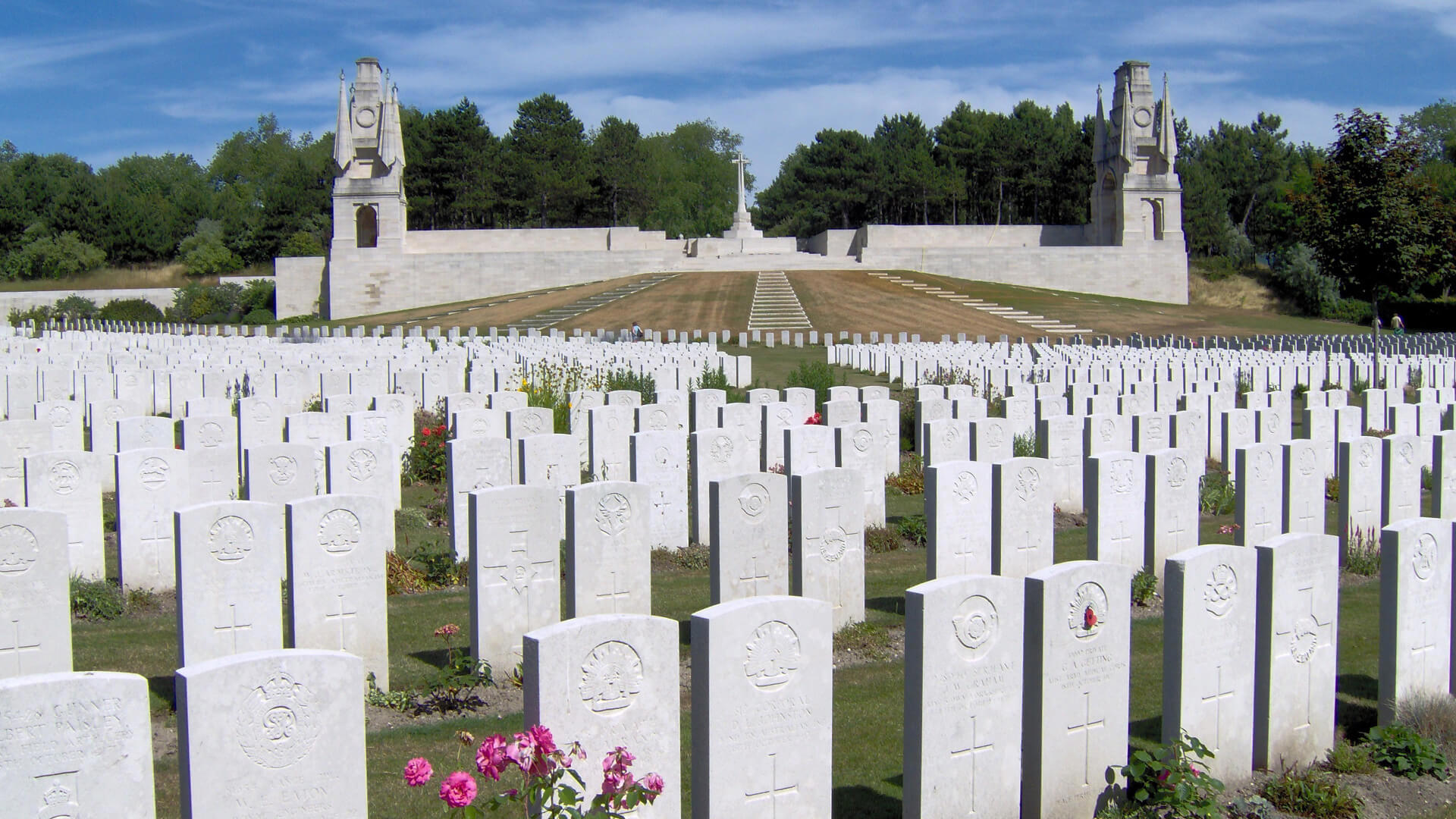
The design was argued over at length, even in Parliament, and many people wanted a cross. In the final design each headstone carries:
- a service or regimental badge;
- the service number, rank, name and unit, so that families could be sure they had found the right Smith or Jones;
- the date of death and age;
- an optional religious emblem: a cross, a Star of David, or none.
Families could add a personal inscription of up to 66 letters, originally charged at 3½d a letter. Brian thought the charge was a mistake, although those who could not pay were never chased. New Zealand rejected the idea altogether, which is why its headstones carry no personal inscription. The lettering was designed so that it can be read at a 45-degree angle along the rows. Where a man held the Victoria Cross, the VC replaces the religious emblem. Brian’s example was the only Leeds man to win the VC in the Second World War. He is commemorated in Algeria, and his statue stands near Leeds Playhouse.
There are more than 30 headstone types and designs. They use Portland stone, granite, slate and sandstone according to the local climate, and pedestal markers are used in earthquake-prone areas such as Gallipoli. Other variations include collective graves for whole bomber crews, German and Polish burials cared for under reciprocal arrangements, and the MoD’s post-1948 headstone with its clipped shoulders.
Crosses, Stones and the Missing
Sir Reginald Blomfield’s Cross of Sacrifice comes in four sizes. The smallest, 14 feet high, stands in cemeteries of 40 to 250 graves; the largest, 24 feet, stands at places such as Tyne Cot and El Alamein. Sir Edwin Lutyens, designer of the Cenotaph, insisted that his eight-ton Stone of Remembrance should come in only one size. It appears only in cemeteries of 1,000 or more graves. Its inscription, “Their Name Liveth For Evermore”, was chosen by Rudyard Kipling, who never found the grave of his only son, John.
Tyne Cot is the Commission’s largest cemetery, with nearly 12,000 graves and 35,000 more names on its memorial wall. Thiepval is the largest memorial, carrying 72,000 names, including a four-figure number of Yorkshiremen. The Menin Gate lists 54,000 names, and the Last Post is still sounded there every evening at 8pm. Other memorials to the missing include the naval memorials at Portsmouth, Plymouth and Chatham, the Malta Memorial, and Tower Hill for the Merchant Navy. Small sites get the same care: one plot on an island off North Carolina holds four sailors whose vessel was torpedoed by a U-boat in 1942.
Closer to Home
Only France has more Commission commemorations than the United Kingdom. The UK has more than 300,000 commemorations, including 170,000 war graves at 13,000 locations, and about 90 per cent of those locations hold ten graves or fewer. Brookwood and Stonefall in Harrogate are the largest. There are also around 37,000 private memorials. At Lawnswood, one family memorial records five brothers. Only one of them, Private L. Stewart, is buried there; the other four are commemorated as far away as Gallipoli and Southampton.
The Work Continues
The Commission now employs about 900 gardeners and has worked with Kew Gardens for more than a century. Its sites face new threats: wildfires at Gallipoli, flooding, and conflict, including damage in Gaza, where staff had to be evacuated. The Menin Gate has just had a two-year restoration ahead of its centenary next year. A specialist recovery unit responds when remains are found during building work or ploughing. Recent reburials included a Yorkshire Hurricane pilot recovered with his aircraft and a young guardsman killed in Normandy. That guardsman’s son, now in his mid-eighties, attended the funeral wearing his father’s medals alongside his own.
Resources and Practical Advice
Brian encouraged members to explore the CWGC website, where archives are being digitised all the time. Records include enquiry files of early correspondence. One Leeds mother, Sarah Smith, wrote to the Commission so persistently about her son that it still remembers her fondly. Other tips from the talk:
- Use the free CWGC app to find war graves in your local cemetery.
- Upload your own research to the Commission’s online stories platform, which has video tutorials.
- Watch the BBC iPlayer documentary on the “war detectives” at Innsworth, who work with the Commission to identify remains.
- Check the CWGC website for dates of forthcoming rededications.
- If you want names added to a town or village war memorial, approach the War Memorials Trust, not the Commission.
- Free volunteer-led talks and tours are available at sites such as Lawnswood and Stonefall.
Questions and Discussion
The questions and comments were wide-ranging:
- One member described an Australian soldier who died in an Essex hospital. She traced him through more than 60 pages of free online Australian records and arranged for the Commission to clean his grave.
- Others recalled Normandy, Vimy Ridge and the gentle wording “Known unto God”, which Brian confirmed was Kipling’s.
- In reply to questions about relatives on memorials to the missing, Brian explained that a soldier receives a headstone only when his body is identified. He described how DNA and war diaries now make that possible, and how early soldiers wore a single identity tag, which was later doubled.
- He said the Merchant Navy dead are named at Tower Hill, while those serving under special Royal Navy contracts are commemorated at Liverpool. He offered to send research pointers to the Society.
Reception
Members’ comments on the evening were warm. One described Brian as “a brilliant ambassador” for the Commission. Others said the cemeteries they had visited were proof of the care he had described.
Key Take-aways
- Commission graves are often close by, in local cemeteries and churchyards.
- Headstone details, enquiry files and the CWGC website give family historians rich evidence.
- The Commission’s promise is for perpetuity, and new names are still being added.
Concluding Remarks
Brian ended with a picture from Sir Fabian Ware to hold in mind this Remembrance Sunday. If the 1.1 million dead of the First World War marched four abreast past the Cenotaph,
“the rear of the column of 1.1 million would be in Durham, and it’d take three and a half days to walk past.”
The Society thanks Brian for a moving and memorable evening.